


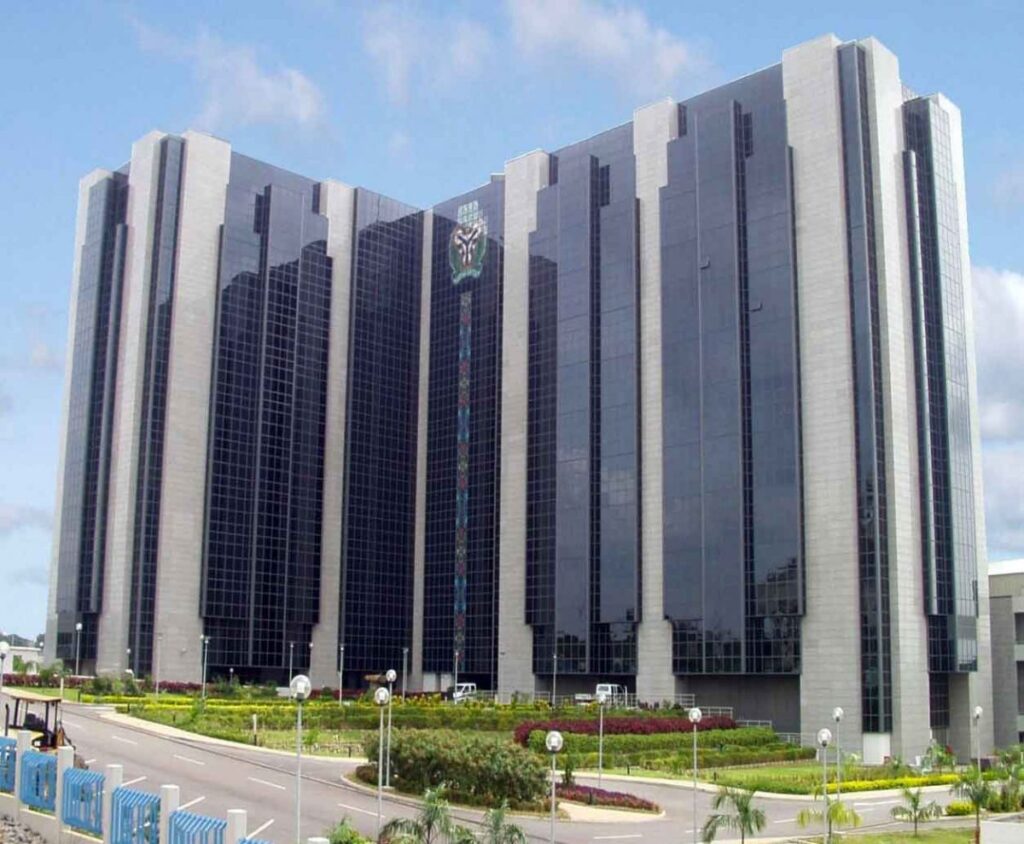
The Central Bank of Nigeria (CBN) Group reported N9.86 trillion total income in its audited consolidated and separate financial statements for last year.
The CBN annual reports and statement of accounst released yesterday, covered the year ended 31st December 2025. It further indicated that the total income for the Bank was N9.76 trillion.
The Bank and the Group recorded a surplus of N86.81 billion and N108.13 billion, compared with the surplus of N165.69 billion for the Bank and N38.84 billion for the Group in the preceeding year.
“In accordance with the provisions of Section 22(1) and (2) of the Fiscal Responsibility Act (FRA), 2007, the sum of N69.45 billion (80% of 2025 operating surplus) was due to the Federal Government, while the balance accrued to general reserve,” the report, signed by CBN Governor, Olayemi Cardoso said.
He also attributed the sterling performance to President Bola Ahmed Tinubu’s support. “The Bank’s achievements in 2025 would not have been possible without the continued support of President Bola Ahmed Tinubu. This is much appreciated,” he said.
Further analysis of the results showed that the value of the Group and the Bank’s balance sheet increased in 2025 as total assets increased by 18 per cent to N138.86 trillion for the Group and N138.66 trillion for the Bank.
“The assets position reflected an increase in external reserves (11.9 per cent) and other assets (299.7 per cent). The increase in total assets was compensated for on the liabilities side by a rise in the CBN instruments issued (100.7 per cent), while the paid-up capital and reserves of the Bank stood at N599.24 billion,” the results said.
The CBN approved a currency indent of 5,706.8 million pieces across the various denominations for 2025. This represented an increase of 20.5 per cent, from the 4,737.5 million pieces, approved in 2024. Of this amount, the NSPM Plc was allocated 2.0 billion pieces (35.0 per cent), while foreign High Security Printers (HSPs) were alloted the balance of 65 per cent.
“As of 31st December 2025, the NSPM Plc delivered 1,239.24 million pieces (62.0 per cent) with a face value of N368.83 billion, leaving 760.76 million pieces (38.0 percent) outstanding. Foreign printers completed the delivery of 2,206 million pieces across the N1,000, N500, and N200 denominations.
The delivery of the supplementary 1,500 million pieces awarded in November 2025 remained in progress as at year-end.
The economy recorded an increase in net foreign exchange inflow, driven by autonomous inflows in the review period. Aggregate FX inflow into the economy at US$109.86 billion in 2025, rose by 13.81 per cent, from US$96.53 billion in 2024.
The development was attributed, largely, to increase in inflow through autonomous sources. Aggregate FX outflow, at $49.05 billion, rose by 27.83 per cent, from $38.37 billion, mainly, due to increased outflow through autonomous sources. Overall, the economy recorded a higher net inflow of $60.81 billion, from $58.16 billion in 2024.
During the review period, the CBN also conducted routine examination of the 34 authorised dealers in the foreign exchange market, comprising 29 commercial banks and five merchant banks, was conducted between April and May 2025.
It said the examination was aimed at ascertaing compliance with rules and regulations of foreign exchange operations, evaluate the utilisation of foreign exchange for eligible transactions, and conduct a trend analysis of foreign exchange flows from major sources.
“The examination covered foreign exchange operations for the period April 2024 to March 2025. Key findings revealed some infractions, and appropriate penalties were recommended,” it said.
The CBN said it continued to promote a safe, stable, and sound financial system using a risk-based supervisory approach.
Liquidity and solvency positions of the banking industry remained robust when subjected to mild and moderate scenarios of sustained adverse economic conditions but could be vulnerable under the severe scenario.
The Bank conducted top-down banking industry stress tests on 34 commercial and merchant banks during the review period to assess their resilience to systemic risks.
The result indicated that the banking industry remained safe, sound, and resilient under mild to moderate scenarios of sustained economic and financial stress.
However, under the severe and prolonged stress scenario, the industry exhibited vulnerabilities. The liquidity stress test as of end 2025 revealed that, the industry liquidity ratio (LR) would decline to 40.31 per cent from the baseline of 60.27 per cent but remain above the 30.00 per cent threshold.
Further simulation results indicated that the liquidity ratio (LR) would fall to 30.53 per cent and 25.73 per cent, under a 3-day and 4-day run, respectively.
The results indicated that although the banking industry maintained adequate liquidity buers under short-term stress, the adequacy of these buers diminished under more severe and prolonged withdrawal pressures and the system became vulnerable.
In the review period, the banking sector remained stable but carried structural concentration risk that could amplify solvency pressures in adverse conditions.
A breakdown of the banking industry’s total credit by sector indicated that oil and gas accounted for the largest share of 26.68 per cent. This
was followed by Others (21.18%), finance & insurance (12.83%), manufacturing (11.44%), general commerce (8.31%), general (7.55%), agriculture (6.39%), and government (5.61%).
The Bank received a total of 23,129 complaints from consumers of financial services in 2025, a rise of 10.53 per cent, above the 20,925 in 2024. The trend reflected increased awareness and improved confidence in the Bank’s consumer complaint resolution process.
The report also showed that a total of 18,824 complaints were resolved, indicating a 9.36 per cent increase over the 17,213 complaints resolved in 2024.
“Total claims in local currency increased to N40.61 billion, from N17.13 billion in 2024. Foreign currency claims also rose reaching $344.2 million, compared with $1.06 million in the preceding year,” it said.
Based on the resolved complaints, the sums of N19.12 billion and $329.3 million were refunded in 2025, compared with N9.66 billion and $0.67 million in 2024.
During the review period, the bank imposed 11 penalties on financial institutions totalling N1.26 billion, for infractions ranging from regulatory breaches and failure to respond to regulatory queries.
In addition, the Bank imposed 21 penalties on financial institutions to the tune of N430.00 million, for infractions ranging from delays in resolving customer complaints to failure to comply with the Bank’s directives.
Cardoso said the current reforms have strengthened Nigeria’s international standing, as evidenced by improved ratings from global agencies including Fitch, Standard & Poor’s, and Moody’s, and the successful exit from the FATF Grey list during the review period.
“These milestones are critical for restoring investor confidence and enhancing prospects for sustainable economic growth amid rising global uncertainties,” he said
He explained that Nigeria’s economic outlook for 2026 remains positive, with GDP growth projected at 4.49 per cent. “This optimism is supported by enhanced foreign exchange market reforms, banking sector recapitalisation, gradual easing of monetary policy stance and the implementation of the Nigeria Tax Reform Acts, 2025,” he said.