


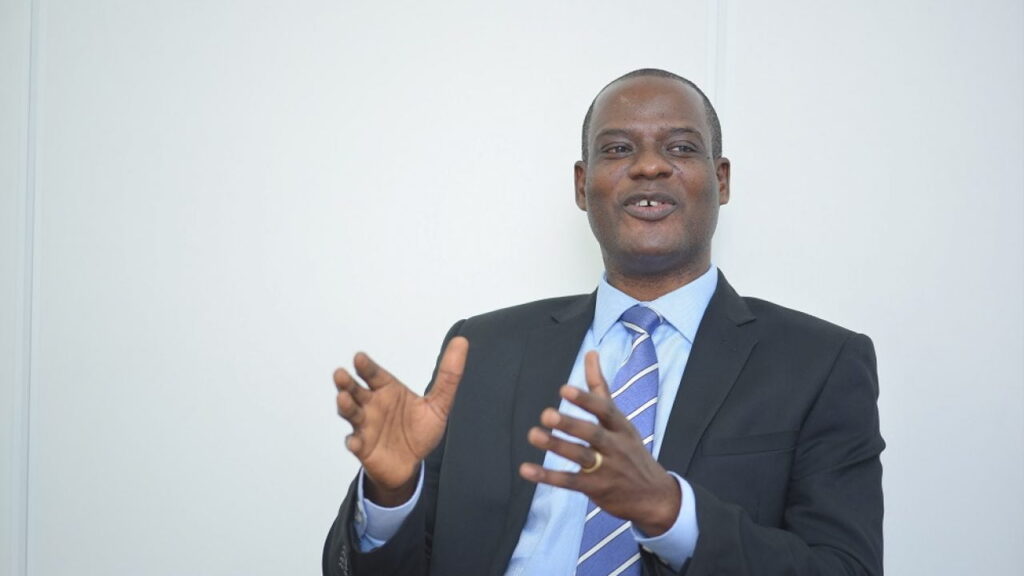
The Chairman of the Intergovernmental Group of Twenty-Four (G-24), Taiwo Oyedele has faulted the high borrowing cost from International Monetary Fund (IMF) and World Bank Group when lending to developing economies.
Oyedele, who is Nigeria’s Minister of Finance and Coordinating Minister for the Economy spoke yesterday during the G-24 press briefing at the ongoing World Bank/IMF Annual Meetings in Bankgkok, Thailand.
He said some estimates indicate that developing countries are paying in the region of about $500 billion more than they should be paying compared to developed countries.
Oyedele advised that develoing countries should look inwards to find areas of savings, areas of revenue mobilization. According to him, the countries should also bear in mind this is the wrong time to impose new taxes or increase the burden of tax particularly on the vulnerable population and productive sectors of the economy.
“Our our charge to both the IMF and the World Bank is to find means of making particularly short-term, more affordable concessional borrowing available to particularly the vulnerable countries, and on a more long-term basis. Find means, framework and policies to mobilize private capital so that public capital that is always constrained is applied only to, for example, social services,” he said.
He however, said that borrowing and debt financing is a necessary condition for growth.
According to him, every country emerging, developed, developing must be able to apply debt financing in a way that it has overall positive impact, particularly to stimulate job, achieve rich and inclusive growth.
He explained that what we have seen by members of the G24, particularly the developing countries such as those in Africa, is the increasing burden of not just high debts or high costs of debts.
Head G-24 Secretariat, Iyabo Masha, said the pursuit of macroeconomic stability is not a bad policy line.
“It is actually the foundation of growth. So, if a country does not have a stable macroeconomic environment, then it’s not even possible to build on structural policies, job-related policies, infrastructure, and all of that. So the emphasis on macroeconomic stability by the IMF and indeed by economists all over the world is an important one, and that is a complementary one to other policies that are fostered,” she said.
He said it’s not macro stability or job-rich growth. The stability itself is the foundation upon which you can build the growth and the prosperity that you want for your people.
Again, for the world, for example, their focus is on creating jobs in livable, livable world, and this is the case for all of us. There’s a particular focus and interest at the D24 about the potential impact of AI, such that if we are not intentional in how we regulate and adopt AI, you can as well have growth and more unemployment.
Oyedele said geopolitical conflicts, shifting trade policies, monetary policy uncertainties, volatile commodity prices, and increasingly frequent climate shocks are interacting to create significant headwinds for global growth.
“These developments impact on emerging markets and developing economies. Project progress towards achieving inclusive and job-rich economic transformation. Considering the challenges, a strong global financial safety net centered on a well-resourced and quota-based international monetary fund is more important than ever,” he stated.
“We call for progress in the implementation of quota realignments to reflect members’ relative positions in the global economy and protect the voice and representation of emerging markets and developing economies and the more vulnerable members,” he said.
Oyedele welcomed IMF program and policy reviews that are responsive to members’ macroeconomic challenges.
He advised that in particular, the program design and conditionality review should support growth, protect social spending and investment reflect political economy and distributional effects, and avoid front-loaded adjustment that could undermine recovery.
“We welcome World Bank’s Group 2030 Strategic Target Map and the ongoing discussion on industrial policy efforts on innovative financing should continue, and further collaboration with multilateral, regional, and national development institutions to support domestic aftermarket development is necessary,” he added.
According to Oyedele, debt vulnerability is a major barrier to inclusive growth in many developing countries.
He called for promotion of predictable, timely, orderly, and coordinated sovereign debt treatment, greater transparency, and better credit rating assessments.
Continuing, Oyedele said climate action must remain guided by equity and the principle of common but differentiated responsibilities and respective capabilities.
“We expect the World Bank Group, regional development banks, and other stakeholders to deliver on the target of at least $300 billion climate finance per year by 2035, as established at the COP 29. Cooperation on international tax reforms must curb profit shifting, tax avoidance, and illicit financial flows. We welcome progress under the United Nations Framework Convention on International Tax Cooperation and the OECD G20 Inclusive Framework,” he said.