


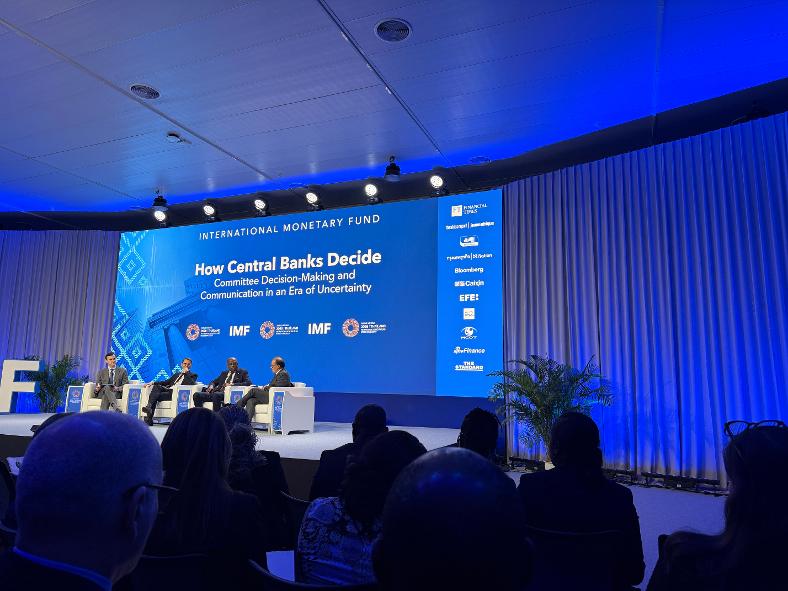
Minister of Finance and Coordinating Minister for the Economy, Taiwo Oyedele and Central Bank of Nigeria (CBN) Governor, Olayemi Cardoso have called on global investors to stake interest on Nigeria’s economy.
Speaking at an investors’ forum held on the sidelines of the ongoing International Monetary Fund (IMF)/ World Bank Annual Meetings in Bangkok, Thailand, they presented 65 investment opportunities to foreign investors as part of efforts to attract capital into key sectors of the domestic economy.
They further used the programme to reaffirm Federal Government’s commitment to bringing inflation rate down to a single digit, assuring that Nigeria was on the verge of achieving seven per cent economic growth.
Cardoso said being able to bring down inflation would affect the ordinary person.
Cardoso said that inflation which is everyone’s nigh mare is already on the decline, adding that what the government has been able to accomplish in terms of having very robust external reserves, “the highest in 18 years, was also something that affects the ordinary person, because without that, a lot of the headwinds that other countries face, we will be facing them, in fact, in perhaps worse way,” he said.
He said that the good thing was that the reforms and the policies were things that were thought through.
He listed the projects for investment to cover oil and gas, power, transport, maritime services, agriculture and food processing, manufacturing, mining, technology, healthcare and urban services.
On the investment drive, government said investors could access information about the transactions through a deal room and a digital platform linked to a QR code. The information includes funding requirements, financing structures, proposed use of funds, minimum investment amounts and possible credit support needs. The platform, he said was designed to give prospective investors access to project details and provide updates as the opportunities develop.
The presentation also formed part of the government’s efforts to attract long-term investment into productive businesses, infrastructure and other activities capable of expanding the economy and creating jobs.
The government used the engagement to outline planned reforms in the power sector, a new tax-credit incentive for investors and other measures to improve the business environment.
The government said it was working towards reforms to improve the electricity market, following concerns raised by investors about power supply and the cost of doing business in Nigeria.
The areas identified include electricity pricing that reflects market conditions, improvements in transmission infrastructure and greater efficiency across the power sector.
Reliable electricity remains a major concern for businesses, many of which depend on generators and other expensive alternatives to sustain operations. The proposed reforms are intended to address some of the challenges affecting businesses and investment in the sector.
The government also plans to introduce a framework to reduce excessive regulation and make it easier for businesses to operate.
Oyedele told investors that regulatory burdens, compliance costs and unclear requirements could cost businesses more than the combined revenue from corporate income tax, personal income tax and value-added tax.
The proposed framework is expected to address regulatory obstacles and improve the environment for investment.
The government presented the Economic Development Incentive (EDI) as an alternative to traditional tax holidays for businesses investing in Nigeria.
The finance minister said the incentive would have to be earned by investors who meet the prescribed conditions. Investors planning to establish factories can obtain further information and support through the investment deal room.
They said the scheme is intended to support qualifying economic activities through tax credits, with the government linking the incentives to the requirements investors meet.
The presentation also covered the government’s broader tax reforms, which are expected to improve revenue collection and strengthen public finances.
Mr Olayemi Cardoso outlined medium-term economic targets, including raising real gross domestic product (GDP) growth to seven per cent by 2027 or 2028.
The targets also include increasing oil production to three million barrels per day, expanding gas production and raising infrastructure stock to 75 per cent of GDP from about 40 per cent.
The targets reflect the government’s ambition to expand economic activity, strengthen infrastructure and increase production in key sectors.
The governor also discussed the relationship between monetary policy and inflation, explaining that the latest policy adjustment was a “reset” rather than a conventional interest-rate cut.
He said market interest rates had been trading substantially below the monetary policy rate, weakening the transmission of the CBN’s policy decisions through the financial system.
The governor said the central bank would maintain a tight monetary policy stance until inflation declined further, adding that single-digit inflation remained a medium-term objective.
The finance minister said achieving single-digit inflation and creating conditions for single-digit interest rates could save the government more than $10 billion, based on 2026 figures.
He linked the potential savings to the effect of lower inflation and borrowing costs on government finances.
The government also announced plans to improve the availability and consistency of economic and fiscal data to help investors make informed decisions.
The finance minister cited differences in tax-to-GDP ratios reported by various sources and said the government wanted to make fiscal information and policy updates more accessible through the Ministry of Finance’s website.
The government he said is working with the National Bureau of Statistics to improve economic information, including employment data and the development of a producer price index to complement the consumer price index.
Oyedele said government wanted to attract more long-term investment into productive sectors rather than depend excessively on short-term portfolio flows into financial markets.
The finance minister said changes in inflation and investment returns could affect the relative attractiveness of different asset classes, while the government’s priority remained attracting capital into activities that expand production and support economic growth.
Job creation also featured in the discussions. A representative of the Development Bank of Nigeria urged the government to focus on the quality of jobs generated by investment.
The minister said Nigeria needed decent jobs, not merely an increase in the number of people employed. He referred to an official unemployment rate of about five per cent alongside a poverty rate above 50 per cent.
Investors also raised concerns about electricity costs, tax treatment of financial investments, liquidity and the ability to exit naira-denominated investments.
The minister said the government could not guarantee that investments would be free from tax but recognised the need for clearer information about applicable rules. He added that the government was working with monetary authorities on liquidity-related issues.
A representative of the Dangote Group cited monetary-policy credibility, regulatory changes and incentives in export-processing zones when discussing the investment environment for the group’s refinery project, valued at about $17 billion.
Another investor spoke about investing more than $1 billion in Nigeria and expanding operations into 10 African countries.
The presentation put the amount raised by banks in the recapitalisation exercise at about N4.6 trillion, with 72 per cent coming from domestic sources and the remainder from foreign investors.
The stronger capital base is expected to support the banking sector’s capacity to finance businesses and other investment opportunities.
Investors also raised questions about government bond issuance, fluctuations in longer-term yields and the effect of borrowing plans on financial markets.
Director General of the Debt Management Office (DMO) Ms. Patience Oniha said the issuance calendar covered both financing needs and new borrowing. She added that issuance volumes were not fundamentally different from those in the third quarter, although activity had been slower in the first and second quarters.
The authorities she noted were monitoring interest rates and investor demand as they managed the borrowing programme.
Cardoso also discussed foreign-exchange reforms, attributing improvements in market functioning to the willing-buyer, willing-seller approach and reduced reliance on direct intervention. He said the premium between official and parallel-market exchange rates had fallen below two per cent.
On food prices, the government cited tariff reductions, food-security investments, improvements in logistics and targeted federal and state spending as part of its response to food inflation.
The investor engagement in Bangkok brought together the government’s investment proposals and its plans for improving the business environment, with the 65 transactions serving as the centrepiece of its effort to attract more local and foreign capital into Nigeria.