
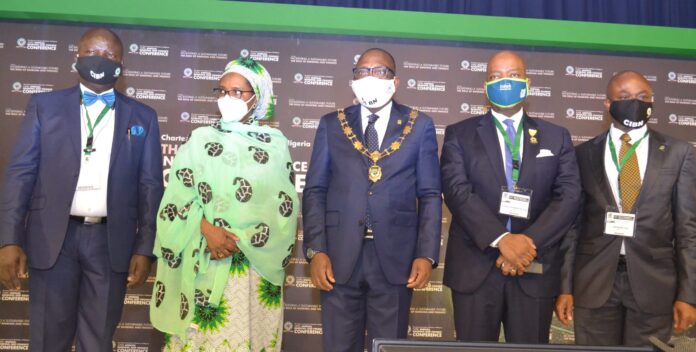
The Chartered Institute of Bankers of Nigeria (CIBN) has urged Nigerians to embrace import substitution models that ultimately promote home grown products and services, economic growth, and sustainable development in the country.
Bayo Olugbemi, President/Chairman of Council of the Institute made the call while delivering his remarks at the 2021 CIBN Fellowship Investiture in Lagos.
The CIBN at its Fellowship Investiture formally conferred its honorary fellowship awards on 14 distinguished bankers in recognition of their contributions to the banking industry and the economy; 77 Associates as Elected Fellows while 146 Senior Management Staff of banks and the academia became Honorary Senior Members of the Institute at the event themed, ‘Nigeria’s Rising Debt Profile: Issues and Implications for Sustainable Economic Development’.
Among those honored are Director-General of the World Trade Organisation (WTO), Ngozi Okonjo-Iweala; the Managing Director of Nigeria Deposit Insurance Corporation (NDIC), Hassan Bello; Central Bank of Nigeria (CBN) Deputy Governor, Kingsley Obiora , Managing Director, SystemSpecs, John Obaro, among others.
In his comment, Obiora said the CIBN has given them the opportunity to be excellent in all they do.
Continuing, Olugbemi said that high debt levels could reverse Nigeria’s economic growth adding that the major concern with borrowing be it, as an individual, organisation or a nation, is simply the purpose of the borrowing and the capacity to repay.
He said: “Over the past 10 years, Nigeria’s public debt profile has been consistently increasing. Data from the Debt Management Office (DMO) shows that as of December 2010, the total public debt in Nigeria stood at $40 billion or 25 per cent of Gross Domestic Product (GDP). More recently, this figure has more than doubled to $84 billion as at 2019 ending. With the emergence of the Covid 19 Pandemic in 2020, these figures further worsened. As at June 2021, Nigeria’s total public debt further increased to $86 billion,” he said
He said that the choice of the topic stems from the growing concerns of Nigerians about the rising debt profile of the country and the need to educate the public on this issue and proffer sustainable management strategies.
In his remarks, Taiwo Oyedele, fiscal policy partner and Africa tax leader at PwC, said that Nigeria’s public debt over the past five years (2015 to 2020) had expanded by an average of 21.02 per cent while the economic growth figure averaged 0.15 per cent.
Oyedele said that revenue, on the other hand, expanded by an average of 5.19 per cent. “By implication, the rate of expansion in public debt in Nigeria is fast outweighing the revenue mobilisation capacity of the government,” he said.

 has urged Nigerians to embrace import substitution models that ultimately promote home)